No-Show Reduction
First-appointment no-show rates start upstream — at intake
First behavioral health appointments have consistently higher no-show rates than established-patient appointments. Completed intake is one of the factors that correlates with appointment retention — because completing intake signals patient commitment to the appointment.
The Problem
Why first-appointment no-shows are high in behavioral health
First-appointment no-show rates in behavioral health consistently run higher than in primary care or specialty medical care — published behavioral health literature suggests ranges of 20–35% for initial appointments at outpatient settings.
The factors are more complex than "patients don't want to come." Ambivalence about treatment, stigma, practical barriers (transportation, childcare), and the cumbersome intake process itself all contribute. Intake is one of the factors practices can actually address.
Intake as a commitment signal
Completing intake is a behavioral commitment signal. Patients who finish their intake form have already invested time and engaged with the clinical process before the first appointment — that engagement correlates with appointment retention. Patients whose intake is incomplete at the 24h reminder mark have a meaningfully higher no-show risk.
The Intakeful Approach
Automated reminders that bring patients back to incomplete intake
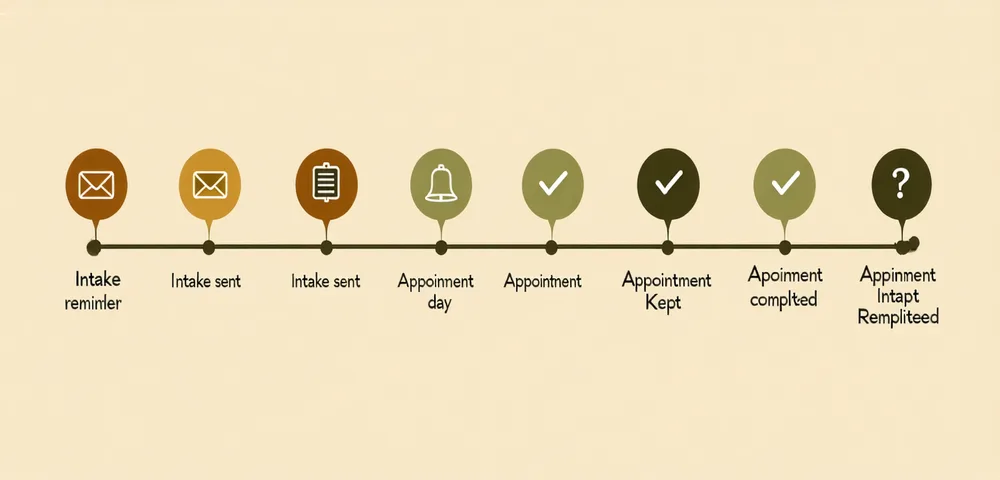
Intake sent immediately
When an appointment is scheduled, the intake link is sent immediately — text and email. The earlier the patient receives it, the more time they have to complete it at their own pace.
48h reminder for incomplete intake
Patients who haven't completed intake at 48 hours before appointment receive an automated reminder — text and email — with a direct link back to their intake form. The message tone is warm and non-clinical.
24h final reminder
A 24h reminder for still-incomplete intake. At this point, the patient record is also flagged for front-desk attention — they can make a direct outreach call if the clinical urgency warrants it.
What We Observe
Directional observations — not fabricated benchmarks
Practices using Intakeful have reported improved intake completion rates after implementing automated reminders. The directional observation: higher intake completion rates correlate with lower first-appointment no-show rates at those practices.
We don't state a specific "Intakeful reduces no-shows by X%" — that claim would require controlled study conditions that early-stage practices haven't run. What we can say: the correlation between intake completion and appointment retention is documented in behavioral health literature, and Intakeful is designed to improve intake completion rates.
Methodology note
When practices using Intakeful share feedback about no-show rate changes, we describe these as directional observations from specific practice contexts — not controlled studies. Other factors (patient population, payer mix, geography, clinician capacity) also affect no-show rates. We believe intake completion is one addressable contributor, not the sole driver.
See the intake completion workflow
Watch the intake reminder sequence in a live demo
We'll walk through the patient experience from intake link to 48h reminder — and what your front desk sees when a patient completes intake versus leaves it unfinished.