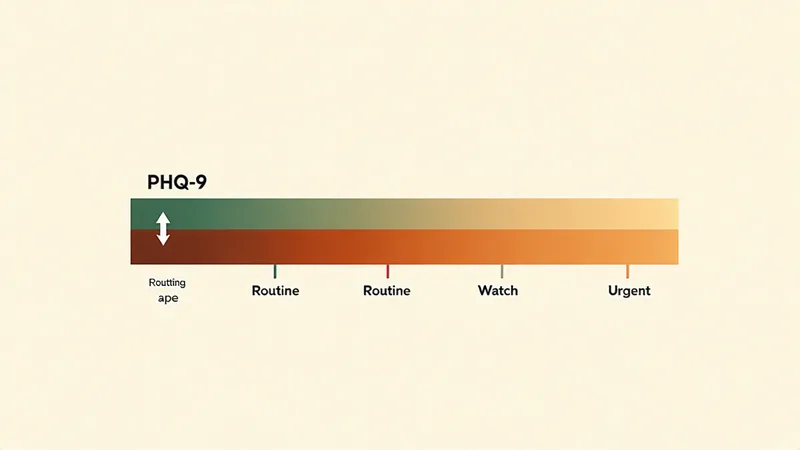
The PHQ-9 Is Everywhere. Routing Logic Often Isn't.
The Patient Health Questionnaire-9 is one of the most widely used and well-validated depression screening instruments in outpatient behavioral health. Most practices already administer it — either at intake or at the first appointment. The PHQ-9's scoring thresholds (0–4 minimal, 5–9 mild, 10–14 moderate, 15–19 moderately severe, 20–27 severe) are well-established, published in the literature, and familiar to most behavioral health clinicians.
What is less common is a defined protocol for what happens when a patient scores 20 at intake — before the first appointment, before a clinician has met them, when the front desk is looking at a triage dashboard and needs to make a decision.
That gap — between a validated screening score and a clinical routing action — is where intake fails patients who need the most careful response.
What "Routing" Actually Means in This Context
Clinical routing in the intake context doesn't mean diagnosis. It means: given what this screening score tells us, what should happen next, and how urgently?
A PHQ-9 score of 6 (mild depression) in a new patient who indicated they're seeking therapy for relationship stress and have no prior behavioral health history suggests a routine appointment scheduling process — match to an available therapist, book within one to two weeks, standard intake follow-up.
A PHQ-9 score of 21 (severe depression) in a new patient who indicated hopelessness in question 9 and has a prior psychiatric hospitalization in their history suggests something different: priority scheduling, review by a clinical supervisor before the appointment is confirmed, possible same-week availability, and documentation that risk has been noted and responded to at intake.
Routing doesn't replace the clinical assessment that happens in the first session. It's the triage step that ensures the right resources — the right clinician, the right urgency level, the right preparation — meet the patient before that first appointment rather than after it.
PHQ-9 Score Thresholds and Intake Routing Logic
The PHQ-9 scoring thresholds from Kroenke, Spitzer, and Williams' original validation work give us a baseline framework. For intake routing purposes, most behavioral health practices configure routing around three bands:
Scores 0–9 (Minimal to Mild): Standard intake processing. Assign to first available clinician matching the patient's presenting concern and insurance. Confirm appointment within the practice's standard scheduling window. No urgency escalation.
Scores 10–19 (Moderate to Moderately Severe): Priority scheduling — try to offer an appointment within one week rather than the standard window. Flag for clinical director awareness if the practice has a supervision protocol for new moderate-severity intakes. Note the score in the pre-appointment clinical summary.
Scores 20–27 (Severe): Immediate clinical director or supervisor review before the appointment is confirmed. Evaluate question 9 (suicidal/self-harm ideation) specifically. If question 9 endorses any ideation, activate the practice's crisis assessment protocol — this may include initiating a Columbia Suicide Severity Rating Scale (C-SSRS) follow-up before the appointment, or scheduling within 48 hours with a clinician who has capacity for higher-acuity new patients.
These thresholds are not hardcoded rules — a 19 with significant question 9 endorsement warrants the same urgency response as a 20. The value of configurable routing logic is that clinical directors can set their own thresholds based on their practice's capacity, clinician case mix, and risk management protocols.
Item 9: The Question That Can't Be Ignored at Intake
PHQ-9 question 9 asks: "Over the past two weeks, how often have you been bothered by thoughts that you would be better off dead or of hurting yourself in some way?" Any endorsement — even "several days" — at intake is a meaningful clinical signal that the intake process needs to document and act on.
We're not saying that every item-9 endorsement at intake requires an emergency response. Many patients who endorse passive suicidal ideation on the PHQ-9 are not in acute crisis, and a measured, clinically informed response is more helpful than an alarming one. What we are saying is that an intake process that collects PHQ-9 data and then files it without a routing protocol for item-9 endorsement has created a liability without protection.
The documentation question matters here: if a patient endorsed item 9 at intake and a clinical response protocol was not initiated, and that patient later experienced a crisis event, the intake record becomes a medicolegal document. The absence of a defined routing action — or the presence of a defined routing action that was triggered and executed — is the difference.
Intake software designed for behavioral health should support this specifically: when question 9 of the PHQ-9 is endorsed at any level, a flag should surface in the front desk view and trigger a defined review protocol — not a generic "high-risk alert" that staff learn to ignore, but a specific action step.
Configuring PHQ-9 Routing in Practice: A Realistic Scenario
Consider a 14-clinician outpatient behavioral health group serving adults and adolescents in a mid-size metro area. They have a mix of therapists (LCSWs and LPCs), two psychiatrists, and a clinical director who oversees intake. Their intake volume runs about 25 to 30 new patients per week.
Before implementing automated PHQ-9 routing, their process was: the front desk received completed paper or PDF intake forms, scanned them, and left them in the clinical director's in-box for review when time permitted. The clinical director might review intakes the same day, or the next day, or — on a busy week — two days later. PHQ-9 scores were not systematically extracted; clinicians reviewed the full form before the first appointment. A patient with a PHQ-9 of 23 was sometimes not known to be high-acuity until the clinician read the form the morning of the session.
After implementing a digital intake workflow with PHQ-9 score routing, their process became: PHQ-9 score is calculated immediately on intake form submission. Scores 20+ surface a same-day clinical director review flag. Item-9 endorsements trigger an additional routing step — the clinical director personally contacts the scheduling coordinator with a priority appointment designation. The clinical director reported that this change eliminated the experience of "discovering" a severely depressed new patient on the morning of their appointment with no preparation.
PHQ-9 Alone Is Not a Complete Clinical Picture
One limitation of PHQ-9-based routing that practices should understand clearly: the PHQ-9 measures depression symptom severity. It is not a comprehensive intake screening. A patient with primary anxiety, trauma, or substance use disorder may present with a PHQ-9 score that underrepresents their clinical complexity.
A well-designed intake screening battery pairs the PHQ-9 with the GAD-7 for anxiety, and — for patients indicating substance use concerns — the AUDIT-C for alcohol use. Practices with higher-acuity caseloads or explicit trauma populations often add the PCL-5 (PTSD Checklist) to the intake battery. Each instrument has its own scoring thresholds and routing implications.
The routing infrastructure that applies to PHQ-9 — defined thresholds, configurable urgency levels, documented actions — applies to each instrument in the screening battery. The goal is not to generate a pile of scores, but to generate a pre-appointment clinical profile that the front desk can act on and the clinician can use.
PHQ-9 administration at intake is clinically sound practice. PHQ-9 administration at intake with no routing protocol attached to the scores is an incomplete process — one that collects the signal without building in the response. Connecting the two is what makes intake screening meaningful.