Why the C-SSRS Has Moved Into Outpatient Intake
The Columbia Suicide Severity Rating Scale — commonly called the Columbia Protocol or C-SSRS — was developed by researchers at Columbia University and validated across multiple clinical populations. It was initially designed for use in clinical trials and inpatient settings. Over the past decade it has moved steadily into outpatient and community-based behavioral health settings, and increasingly into intake screening workflows.
The reasons are straightforward: the C-SSRS provides a structured, validated framework for assessing suicidal ideation and behavior that is more specific than a single PHQ-9 item 9 endorsement and more reproducible than an unstructured clinical conversation. Its "Since Last Visit" and "Lifetime/Recent" versions allow consistent reassessment over time. Its use in intake specifically has been driven by the recognition that suicidal ideation in new patients often goes undetected until the first session — sometimes after a two-to-three-week wait — and that by the time the clinician meets the patient, the window of first contact has already passed.
Using the C-SSRS at intake is a clinically defensible practice with real safety benefits. It is also a practice that, done without supporting infrastructure, creates significant documentation and liability exposure for outpatient practices that are not equipped to respond to what they find.
The Infrastructure Problem
The C-SSRS produces structured, scoreable output. The ideation subscale ranges from 1 (passive ideation: "I wish I were dead") to 5 (active ideation with intent and specific plan). The behavior subscale records preparatory behaviors, interrupted attempts, aborted attempts, and actual attempts. Any ideation at level 3 or above (active ideation with method but without plan or intent) warrants a defined clinical response in an outpatient setting.
Here is where outpatient intake practices frequently fall short: the C-SSRS is administered, a score is recorded, and the result is filed with the intake packet. The clinical response to that score is not defined in the intake process. It happens — if it happens — when a clinician reviews the intake forms before the appointment. Which might be the morning of the appointment. Which might be two weeks after the C-SSRS was administered.
That gap — between screening result and clinical response — is where liability lives. Not just legal liability, but clinical liability in the full sense: a patient who endorsed active suicidal ideation at intake and did not receive a structured response is a patient whose risk was identified without being addressed. The intake record documents the identification. The absence of a response protocol documents the gap.
What Routing Infrastructure Needs to Handle
A C-SSRS embedded in an intake workflow must have defined routing rules for each ideation level. These rules should be configured by the clinical director based on the practice's capacity, clinician availability, and crisis response protocols. The configuration question is not "should high ideation trigger a response?" — it should. The questions are: what level of ideation, what response, by whom, within what timeframe?
A practical framework that many outpatient practices use:
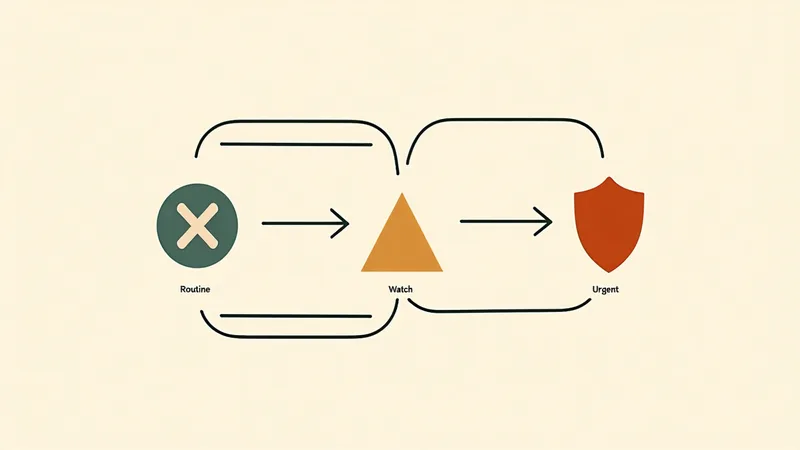
- C-SSRS ideation levels 1–2 (passive ideation, no method): Flag in intake dashboard for clinical director review; schedule within standard window but note elevated risk in pre-appointment summary; ensure assigned clinician is aware before the session.
- C-SSRS ideation level 3 (active ideation, method present, no plan/intent): Same-day clinical director review; priority scheduling within 3–5 days; direct outreach call to patient by a clinical staff member — not an automated reminder — before the appointment.
- C-SSRS ideation levels 4–5 (active ideation with intent and/or plan) or any recent behavior endorsed: Immediate clinical director or on-call clinician contact; evaluate need for same-day or next-day appointment, crisis line referral, or higher level of care. Document the decision chain explicitly.
These are examples, not prescriptions. Each practice must define its own thresholds based on its clinical staffing and crisis response capacity. What cannot be left undefined is the decision tree itself.
Documentation: What the Record Needs to Show
When a patient endorses suicidal ideation at intake, the record must show two things: that the ideation was identified, and that a defined response was taken (or that the reason no response was taken was documented). "Patient endorsed C-SSRS ideation level 3 at intake; clinical director notified; priority scheduling initiated; patient contacted on [date] by [staff name]" is a protective record. "C-SSRS administered at intake" with no follow-up documentation is not.
In the medicolegal context, the question after an adverse outcome is not only "was the patient screened?" — it's "what did the practice do with what the screening found?" A C-SSRS result in the intake file is evidence that the practice knew. What the practice did with that knowledge is what the documentation must establish.
Paper-based intake processes — and even many digital intake systems that don't provide structured clinical routing — make this documentation difficult. The C-SSRS is administered, but there is no automatic mechanism linking the result to a documented clinical action. The action may have happened, but the documentation chain is fragmented across emails, phone logs, and staff memory.
Intake software that is designed for behavioral health should handle this specifically: a C-SSRS result above a defined threshold should trigger a documented workflow — a visible flag in the clinical dashboard, a time-stamped review record, a log of the clinical director's response decision. The documentation should be complete without requiring staff to remember to document it separately.
The Patient Experience Question
There is a legitimate clinical and ethical question that practices using C-SSRS at intake should address thoughtfully: is it appropriate to ask someone about suicidal ideation before they have met a clinician?
The evidence on this is actually reassuring. Research on asking about suicide — including studies on the C-SSRS specifically — has consistently not found evidence that asking increases suicidal ideation or behavior. The concern that asking "plants the idea" is not supported by the data. For patients who are already experiencing suicidal ideation, being asked about it in a structured, non-alarmist way at intake may actually increase the sense that the practice takes their situation seriously.
What matters is how the question is asked. A C-SSRS embedded in a mobile-accessible intake form, preceded by language that contextualizes the screening as standard practice for all new patients and that provides a crisis resource line (the 988 Suicide and Crisis Lifeline) at the point of the question, is a different experience from a paper form handed to a patient in a waiting room with no context. The intake infrastructure shapes the patient experience of the screening as much as the screening itself does.
A Scenario That Illustrates the Difference
Consider two 8-clinician outpatient behavioral health practices with similar patient populations and similar intake volumes — roughly 18 to 22 new patients per week.
Practice A administers the C-SSRS as part of a paper intake packet. Forms are collected, scanned, and placed in the clinical director's review folder. The clinical director reviews them when time allows, typically within one to two business days. C-SSRS results are noted but there is no formal protocol for action based on score level.
Practice B uses a digital intake workflow with C-SSRS scoring built in. Any ideation endorsement at level 3 or above generates an immediate alert to the clinical director's dashboard, time-stamped and requiring a documented response — either a same-day action or a clinical note explaining why the action was deferred. The clinical director receives a text notification for level 4 and 5 endorsements.
Both practices are screening for suicide risk at intake. Only one has infrastructure that ensures the screening result produces a defined and documented clinical response. We're not saying Practice A is negligent — many practices operate without this infrastructure because it hasn't been readily available. We're saying that as the C-SSRS becomes a standard intake screening tool in outpatient behavioral health, the expectation that practices have response protocols attached to their screening results is rising alongside its adoption.
Screening without routing is a half-measure. For a clinical instrument measuring suicide risk, half-measures carry costs that other screening gaps don't.